










Erikson’s Stages of Development: A Lifespan Guide

Dr Kazi, SeemaFact Checker: Dr Kazi, Seema

Human development does not mean growing physically and getting older, but it’s about evolving emotionally, psychologically, and socially.  Erik Erikson, a famous psychoanalyst, laid out a development theory that describes the eight psychosocial stages of development and how each one impacts an individual’s personality, identity, and overall mental health. 

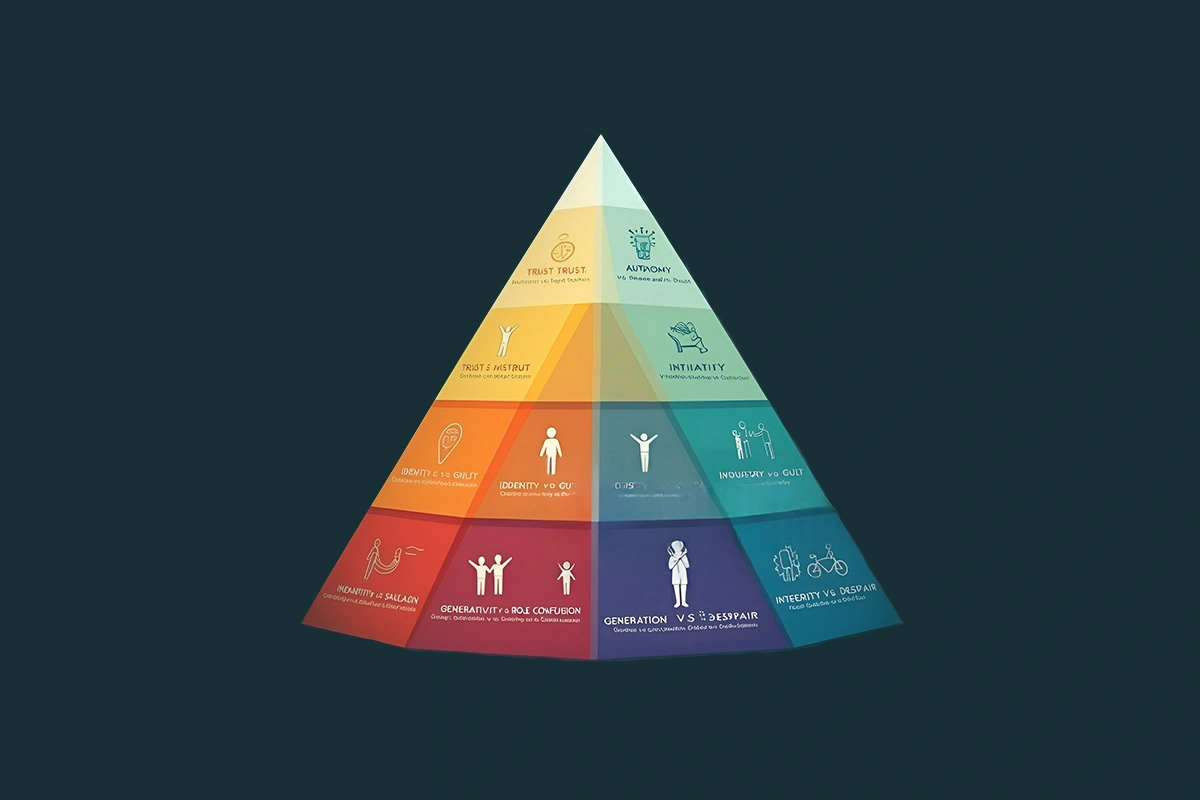
Erikson’s stages of development give a complete series of human development that explains how a person progresses through each stage and shapes their personality.

Table of Contents

Introduction to Erikson’s Psychosocial Theory

Introduction to Erikson’s Psychosocial Theory

Erik Erikson describes the developmental challenges that each individual encounters throughout the eight psychosocial stages of development, from infants to adults. Each stage offers a conflict that will contribute to a person’s emotional and social development. Resolving the conflicts at each stage is necessary to secure positive development. From learning trust as an infant to resolving the psychosocial conflict of adulthood to achieve the virtue of purpose, Erikson’s stages of development illustrate the psychology, sociology, and emotive reasoning of human behavior and feelings. His theories have influenced the entire globe, especially in psychology, education, and mental health.

From nurturing a toddler to helping a teenager discover identity, or an adult searching for the meaning of life, these stages show how our experiences influence our personalities. Erikson’s stages of development have continued to be a cornerstone in psychology that has provided an enduring understanding of the human experience.

Concept Behind Erikson’s Developmental Stages

Every stage has a crisis or conflict, which gives you an opportunity to grow and learn. When you start understanding the development process, it helps you to learn from that. Otherwise, unaddressed problems can go back to manifest later in life in the form of stress, anxiety, depression, or personality disorders.

Erik Erikson considered that the development process remains active across the whole life, not only during childhood. His psychosocial theory also focuses on the importance of social interactions and experiences in personality development.

Also, Erikson, unlike Freud, does not focus on the biological drives, but on social connection and identity. He suggested that we experience eight stages between infancy and late adulthood, and each is characterized by a central conflict, e.g., trust vs mistrust or identity vs role confusion.

Concept Behind Erikson’s Developmental Stages

Erikson’s proposed two faces that cover each stage. The early stages are defined by two opposing psychological factors: the positive adaptive and the negative maladaptive. Handling these challenges helps to shape their identity and personality.

Let’s suppose a person balances these two tendencies; they develop a sense of pride or strength, which is something that helps them to grow. On the contrary, if a person struggles to balance these tendencies, it can create emotional and mental health issues later in life.

Here is a summary of Erikson’s stages of development:

Stage Age Range Conflict Key Virtue Example
1 Infancy (0-1 year) Trus vs Mistrust Hope Can I trust the world?
2 Early childhood (1-3 years) Autonomy vs Shame and Doubt Will Can I do things myself?
3 Pre-school (3-6 years) Initiative vs Guilt Purpose Is it okay for me to take charge?
4 School age (6-12 years) Industry vs Inferiority Competence Can I make it in the world?
5 Adolescents (12-18 years) Identity vs Confusion Fidelity Who am I, really?
6 Young adulthood (18-40 years) Intimacy vs Isolation Love Can I form a lasting relationship?
7 Middle adulthood (40-65 years) Generativity vs Stagnation Care Am I contributing to something meaningful?
8 Late adulthood (65 + years) Integrity vs Despair Wisdom Was my life worth living?
Trust vs. Mistrust (Infancy Stage)

Trust vs. Mistrust (Infancy Stage)

The first stage- Trust vs. Mistrust. This is a very important stage of life, which begins emotional development. Between 0-18 months, infants learn whether they can trust the world around them or not. In this stage, the infant is completely dependent on caregivers for everything.

When infants experience love, care, and affection from caregivers, they develop a sense of trust and security.  This results in the development of hope, which means an infant develops a sense of trust and belief that their needs will be met.

Whereas, if the caregiver fails to provide security, love, and warmth, the child will be unable to trust the world, causing anxiety and fear. These infants may struggle with mental health conditions like mood disorders, depression, and anxiety later in life.

Real-Life Example:

Let’s suppose a baby who is crying for a long period without attention. Sometimes he gets fed, and others, he doesn’t. The baby begins to emotionally disturb and leading to mistrust. 

Quick Insight:

“The first bond a baby forms defines how they will connect with others for the rest of their lives.” – Erik Erikson

Autonomy vs Shame and Doubt

At this stage of development, children start asserting control over things on their own; they start walking, eating, and choosing their toys. This is when the stage of autonomy vs. shame and doubt begins. 

After learning the trust or mistrust from the first stage, the child is now trying to attempt things on their own, discovering their self 

Supportive caregivers will be able to encourage children to explore within safe, healthy, and controlled environments. On the other hand, overprotecting, ridiculing, and constant correction can make children feel shame. This is when kids start self-doubting and become hesitant and self-reliant. 

Autonomy vs Shame and Doubt

Psychology Insight:

Erikson regarded autonomy to be the willpower foundation. 

Modern Suggestion: This stage illustrates to parents the importance of allowing kids to make minor mistakes, as doing so helps build emotional resilience.

Initiative vs. Guilt (Preschool Stage)

Initiative vs. Guilt (Preschool Stage)

This Erikson stage of development starts at pre-school age. The capabilities of the child at this stage determine if they’ll be future leaders or followers. At this stage, they start to understand and use their power to control the things and situations surrounding them. This leads them to develop a sense of aims and goals to achieve for their future. 

If the child fails to cope with this developing stage, they may build a sense of guilt, constant self-doubt about their decisions and thoughts, and a lack of initiative-making skills. 

Quick Thought:

Overly controlling parenting can suppress a child’s natural initiative.

Key Takeaway:

This is the stage where parents and caregivers should start allowing them to handle their situations independently and appreciate their efforts to nourish their future leadership personality. 

Industry vs. Inferiority (School Age Stage)

This psychological development stage begins from the early age of schooling and can last up to 11 years of age. This is an important period in a child’s life as they start to face new challenges in their lives, mostly associated with their academic and social interaction, and try to manage them effectively. 

Hence, the children who are appreciated by their parents, older siblings, and teachers start to believe in their skills. Their achievements, capabilities, and schools of thought start to build towards the concept of achieving their goals and fulfilling their dreams. 

Industry vs. Inferiority (School Age Stage)

Deep Insight:

This stage is mainly about a child discovering their individuality. However, if a child fails to do so, the result may be a sense of inferiority and incompetence in the future. 

Not to Forget:

A child who feels capable will keep trying, even when things get hard.

Identity vs. Role Confusion (Adolescent Stage)

Identity vs. Role Confusion (Adolescent Stage)

This stage often starts as a turbulent teenage period, and it shapes the beliefs and values that develop into a person’s lifelong personality. In psychology, an identity is defined as a set of ideals, values, perspectives, concepts, and beliefs that shape a person’s behavior. From influencing our social interactions with our loved ones to influencing our thoughts on our own experiences, identity gives all of us an extensive yet comprehensive sense of self. 

Children who come out of this stage with appreciation, acknowledgement, and encouragement later develop into a person with strong beliefs of independence and control. However, the one who receives backlash or negativity from their surroundings will feel confused and insecure about themselves, despite doing their best. 

Quick Thoughts:

At this stage, children are overwhelmed by all the new experiences, concepts, ideas, and challenges they are facing every day. Therefore, it is important to reassure them and acknowledge their feelings. 

Erikson’s POV:

This stage leads to fidelity, the ability for a person to live by society’s expectations and standards. 

Intimacy vs. Isolation (Young Adulthood Stage)

As shown by its name, the young adults of this stage crave establishing loving and intimate relationships with other people. This psychology stage usually begins at 19, and if successful, the person may create a strong relationship. However, failure or confusion at this stage can create unfavorable outcomes like loneliness and lifelong isolation. 

This stage is important for social life interaction skills as the person explores bonds with family, friends, and loved ones and tries to build meaningful relationships with them. 

Intimacy vs. Isolation (Young Adulthood Stage)

Outcome:

The development of stage 5 of Erikson’s psychology determines if the person can manage healthy relationships with surrounding people or will be a less-committed person. 

A Quick Example:

A man who had experienced enormous love, care, and acknowledgement from his parents in childhood has a high chance of becoming an affectionate and understanding parent for his children. 

Generativity vs. Stagnation (Middle Adulthood Stage)

Generativity vs. Stagnation (Middle Adulthood Stage)

This stage starts at around age 40 and revolves around the psychological needs of creating impacts that will last longer than the person. In this phase, the person aims to have a prominent mark on society. In psychology, generativity refers to one’s sense of care and responsibility, not only towards oneself but to others, too. Whereas stagnation means lack of activity, development, or growth. 

If a person is successful in this age, they will have a strong feeling of accomplishment throughout their life. However, if failure occurs, the person will struggle with isolation, a constant feeling of uselessness, and be disconnected from the world. He will consider himself a useless and meaningless contribution to society, a person who won’t be remembered by anyone for anything. 


Integrity vs. Despair (Late Adulthood Stage)

This is the final Erikson’s development stage, which starts at the age of 65 and lasts throughout life, covering the phase that is basically “Maturity.” The stage of integrity vs. despair is basically a reflection of a person’s whole life. In this age, life becomes slow and weak, and the person gets plenty of time to evaluate their whole life and make a self-judgement. 

Thus, if you are satisfied with your life and proud of your accomplishments, you will age with a sense of peace and grace. However, if you are disappointed with your life, you’ll fall into despair. Furthermore, your life will end in regrets, unhappiness, and unfulfillment.

Integrity vs. Despair (Late Adulthood Stage)

Once, Erikson quoted:

Success is in the belief that we have achieved our goals and found happiness, leading to the feeling of integrity, “a sense of coherence and wholeness.”

Thus, we all agree that:

A peaceful heart is life’s final reward! 

Influence of Erikson’s Psychosocial Stages on Modern Developmental Psychology

Influence of Erikson’s Psychosocial Stages on Modern Developmental Psychology

Erik Erikson’s stages of development have, without any doubt, a significant impact on today’s modern era psychology development concept. His 8-stage theory covers the development of concepts, ideas, beliefs, values, and perspectives, thoughts, and feelings, right from the moment of infancy till death. It provides a broad and extensive framework to thoroughly evaluate a person’s social nature. Furthermore, it also shows the importance of different personality perspectives throughout life that can lead to a meaningful, fulfilling, and absolutely satisfactory life. Today, the students, educators, researchers, counselors, and psychology experts consider Erikson’s stages of psychological development as a foundation. 

Key Takeaways from Erikson’s Theory of Development

The main takeaway of Eric Erikson’s theory of development was that the psychology of a person evolves throughout life. Whether the person has just started to socialize or is in their teenage years, is thinking of starting a family, or has spent more than half a decade of life, their thoughts, beliefs, perspectives, ideas, and values are always changing. 

He divided the psychological development process into eight steps and emphasized how important it is to attain success in every step if you have a positive identity for your future self. Hence, to lead a satisfactory and fulfilling life, understanding the ideas 

Key Takeaways from Erikson’s Theory of Development

Frequently Asked Questions

Psychosocial development refers to the development of a person’s psychological abilities, associated with emotional and social concepts. These are a set of abilities by which a person learns to understand, interact, and build relationships with other people.

If the psychosocial stage is successful, the person may struggle with conflicts and difficulties in that regard. For example, failure to build trust in children can cause confidence and insecurity after growing up. Similarly, if a child is not appreciated or acknowledged enough in childhood, he may develop, he may grow up to be a low self-esteem adult. 

Erikson’s development stages help the parents, caregivers, and teachers understand the psychological needs of the child while growing up. Hence, they can create an environment that is healthy for their mental health. An environment where their efforts are appreciated, their thoughts are valued, and they are given enough affection to lead a satisfactory life. 

The main goal of Erikson’s theory is to develop a psychosocial healthy mindset, along with building a strong and positive identity through all the prominent phases of life. By deeply understanding the emotional needs and social experiences, one can lead a healthy and successful life without any regrets or doubts. 

Conclusion

So, wrapping up the discussion, Eric Erikson’s theory of psychological development is purely based on the concept of human emotional and social needs. Just like our surroundings, experiences, and situations are changing, our mental health and its needs are also constantly evolving. 

Revision History

Updated publication: Jun 18, 2026
Author: Dr. Sacha Cohen, Fact Checker: Dr Kazi, Seema
Original Publication: May 28, 2025

Author

Dr. Sacha Cohen

Medical & Clinical Educator
Dr. Sacha Cohen is a healthcare professional and medical content writer with experience in clinical training and academic writing. She specializes in creating research-based, accessible healthcare content. With a foundation in medical education and hands-on clinical practice, she brings depth and clarity to every piece she writes. Passionate about making medical knowledge understandable, she aims to educate and inspire her readers.

Picture of Dr. Kazi, Seema

Dr. Kazi, Seema

Dr Seema Kazi is a board-certified psychiatrist and a proficient Medical Director of Mid Cities Psychiatry at Euless, Texas.

Fact Checker

Dr. Seema Kazi, MD

Dr. Seema Kazi

Founder & Medical Director
Dr. Seema Kazi is the compassionate force behind Mid Cities Psychiatry, where her vision has shaped a practice rooted in empathy, excellence, and patient-centered care. As a triple board-certified psychiatrist in Psychiatry, Geriatric Psychiatry, and Internal Medicine, Dr. Kazi brings over 20 years of clinical experience to her leadership role.

Revision History

Updated publication: Jun 18, 2026
Author: Dr. Sacha Cohen, Fact Checker: Dr Kazi, Seema
Original Publication: May 28, 2025

Author

Dr. Sacha Cohen

Medical & Clinical Educator
Dr. Sacha Cohen is a healthcare professional and medical content writer with experience in clinical training and academic writing. She specializes in creating research-based, accessible healthcare content. With a foundation in medical education and hands-on clinical practice, she brings depth and clarity to every piece she writes. Passionate about making medical knowledge understandable, she aims to educate and inspire her readers.

Picture of Dr. Kazi, Seema

Dr. Kazi, Seema

Dr Seema Kazi is a board-certified psychiatrist and a proficient Medical Director of Mid Cities Psychiatry at Euless, Texas.

Fact Checker

Dr. Seema Kazi, MD

Dr. Seema Kazi

Founder & Medical Director
Dr. Seema Kazi is the compassionate force behind Mid Cities Psychiatry, where her vision has shaped a practice rooted in empathy, excellence, and patient-centered care. As a triple board-certified psychiatrist in Psychiatry, Geriatric Psychiatry, and Internal Medicine, Dr. Kazi brings over 20 years of clinical experience to her leadership role.

Subscribe to Our Newsletter